
You came in with instincts. You leave with frameworks. The difference between an activist and a strategist is the ability to name why you do what you do — and to choose differently when the situation demands it.
What You Built
Over five modules, you assembled a foundational analytical toolkit that will inform everything else in the Academy curriculum:
Module 1: What Is Power?
The lens. Power operates through three interconnected forms — structural (laws, institutions, economic systems), cultural (narratives, beliefs, "common sense"), and interpersonal (relationships, charisma, social capital). Understanding which form is at work determines which strategy will be effective.
Module 2: Intersectionality as Power Analysis
The depth. Single-axis analysis produces strategies that leave the most vulnerable behind — and ultimately weakens the movement. The strongest strategies center the most marginalized, because solutions that work for those at the most complex intersections tend to work for everyone.
Module 3: How Movements Win (and Why They Fail)
The evidence. Successful movements share five conditions: clear theory of change, multi-front strategy, sustained infrastructure, adaptive leadership, and broad-but-principled coalition. Missing any one of these predicts failure.
Module 4: Theories of Change
The toolkit. Four theories — institutional reform, people power, narrative transformation, and community-building — are strategic choices, not ideological commitments. Effective movements deploy multiple theories simultaneously.
Module 5: Strategic Orientation
The compass. Inside/outside strategy and the righteousness/relationship spectrum define how you approach power. Movements need people at every point on both spectrums — and the most effective activists can move along them as conditions demand.
Your Responses
Here is everything you wrote across all five modules. This is your analytical record — a snapshot of how you think about power, strategy, and change right now. As you progress through the Academy, you'll revisit these answers and see how your analysis deepens.
No saved responses found. Complete the exercises in Modules 1–5 to see your answers here.
Download Your Work
Save a PDF of all your responses from this course — your personal power analysis document.
Your Certificate
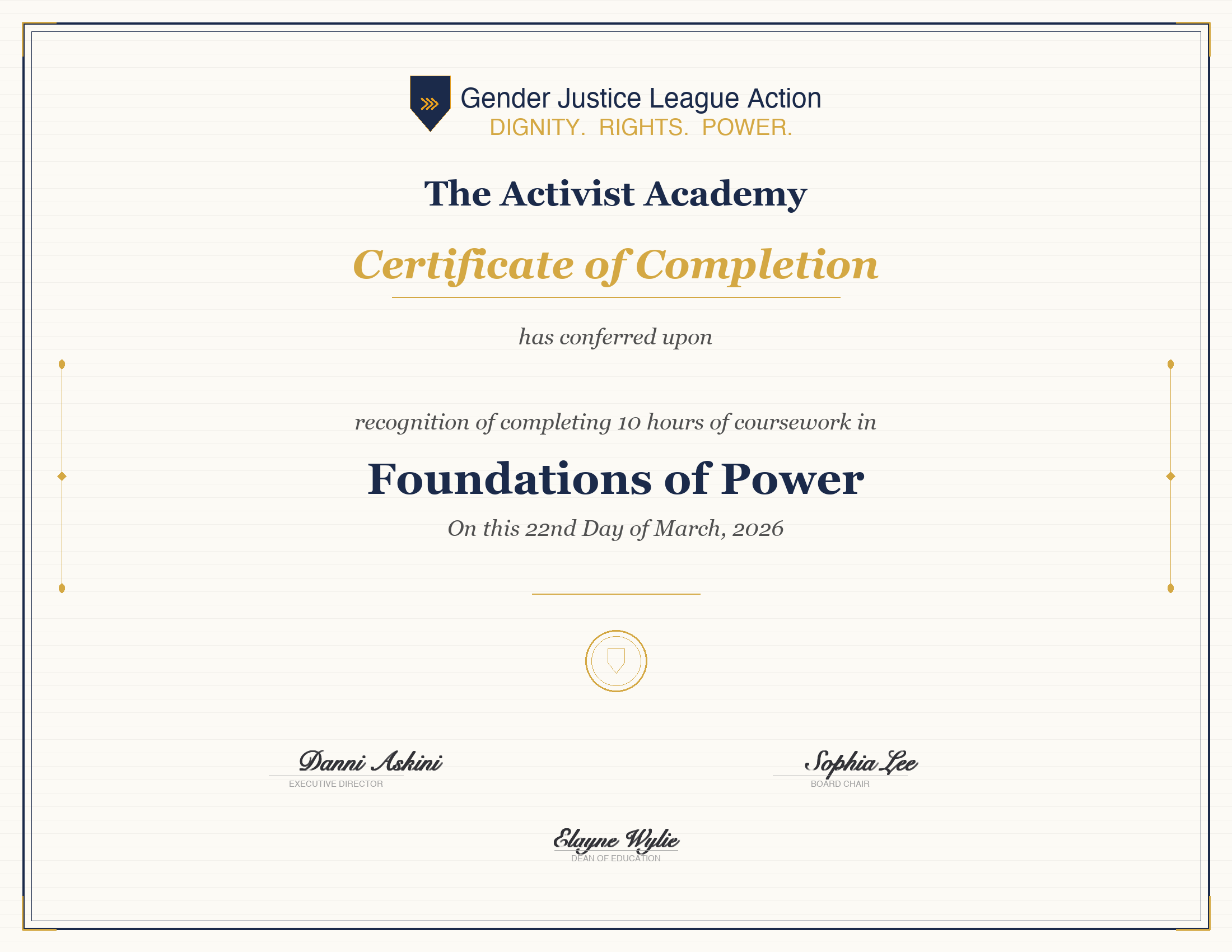
You've earned it. Download your completion certificate — and share it if you'd like.
Your Badge
Share your achievement on social media or add it to your Activist Academy profile.
What's Next?
Foundations of Power gave you the analytical frameworks. The next schools give you the skills to act on them.

The natural next step. Learn the relational skills that turn analysis into action — the one-on-one conversation, public narrative, group formation, and team structure. If Foundations of Power is the map, Organizing is the first step on the terrain.
Organizing & Base-BuildingTake the Power Analysis Grid from Module 1 to the next level. Learn to map decision-makers, allies, opposition, and the moveable middle — and build a complete strategic action plan.
Power & Resource MappingNot sure which school to take next? Take the Discovery Engine quiz to get a personalized recommendation based on your archetype and strategic orientation.